Guide
Roman numeral date tattoos: a checklist before you book
A date in Roman numerals is one of the most popular tattoos: a birth, a wedding, a loss. It looks timeless and stays private. But a mistake in a tattoo is hard to undo, so work through these six steps first.
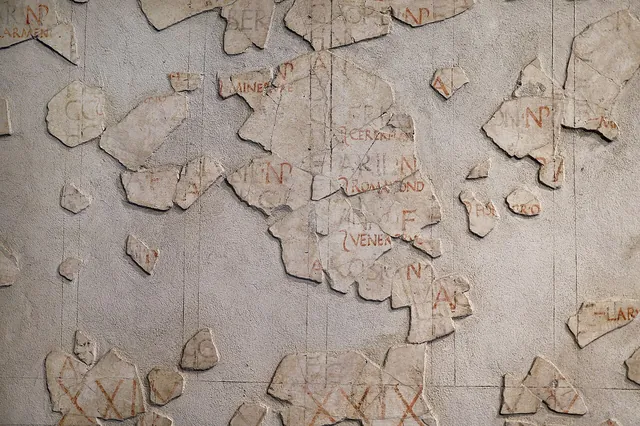
One note before you start: writing a date as day, month and year in numerals is a modern style, not something the Romans did. They counted the days of each month from three fixed points (the Kalends on the 1st, the Nones on the 5th or 7th, and the Ides on the 13th or 15th) and usually named a year after the two consuls in office. The modern style simply borrows their numerals, which is what makes it so readable today.
1. Get the day and month the right way round
This is the most common regret. Australia, the UK, New Zealand and most of Europe write the day first. The United States writes the month first. The same numerals can mean two different dates:
| Numerals | Day first reads as | Month first reads as |
|---|---|---|
| V.X.MMXIX | 5 October 2019 | 10 May 2019 |
| III.IX.MMXXIV | 3 September 2024 | 9 March 2024 |
| XII.VI.MCMXCIV | 12 June 1994 | 6 December 1994 |
Use the order you and the people around you naturally read. If the day is 13 or more, there's no ambiguity (XIV can't be a month), but anything up to XII can be misread. The date converter writes your date out in words, and warns you when it could be read another way.
A third option is year first (YYYY.MM.DD). It's read the same way almost everywhere and sorts neatly, though it's less common in tattoos.
2. Choose the full year or two digits
The full year carries the most meaning but can be long. 1988 is MCMLXXXVIII, eleven letters on its own. Two digits are shorter: '88 is LXXXVIII.
- Years ending in 00 can't be shortened. There's no Roman numeral for zero, so 2000 must be written MM.
- 2001 to 2009 shorten to a single numeral ('05 is just V), which can look like part of the day or month. Consider the full year, such as MMV.
- Some short forms are long anyway. '88 (LXXXVIII) is eight letters, while the whole of 2010 is just MMX.
Every year page shows both forms and how long they are.
3. Pick a separator
Something has to separate the day, month and year, or XIVIIMMXV becomes unreadable. Dots are the classic choice: XIV.II.MMXV. Bullets and dashes work well too, and spaced bullets (XIV • II • MMXV) give a more open look.
For an authentic touch, Roman inscriptions separated words with a raised dot, and sometimes with a small ivy leaf (❦). Both are in the converter's separator list. Hearts and stars are popular for anniversaries and memorials.
4. Decide on the layout
- One line suits the forearm, collarbone, wrist and along a finger.
- Stacked, with each part on its own line, suits the ribs, spine and the back of the neck.
- Inside a design: a date below the centre of a clock face set to the time of birth is a popular way to record both.
The tattoo preview shows your date in ten open-source fonts, one line or stacked, on your skin tone.
5. Make it big enough to last
Ink spreads very slightly under the skin over the years, so fine lettering gradually softens. Small, tightly packed numerals like IIII or XIII are most at risk, because the strokes sit close together. As a rough guide, letters under about 3 mm tall may blur over time; ask your artist what they recommend for your placement and style.
- Simple serif and sans lettering holds up best at small sizes.
- Script and blackletter have fine strokes and need more room.
- Letter spacing helps keep strokes from merging.
When you print a stencil from the preview, it tells you how tall the letters will be at the size you choose.
6. Check every numeral
Most numeral mistakes come from shortcuts that look right but break the rules:
| Instead of | Write | Why |
|---|---|---|
| MIM | MCMXCIX | I can only come before V or X |
| IIX | VIII | Only one letter can be subtracted |
| XIIII | XIV | Four in a row isn't standard (except IIII on clocks) |
| MMXVIIII | MMXIX | Nine is IX |
Before your appointment, type the date into the converter, read the words it gives back, and take a downloaded PNG or a printed stencil to your artist so nothing is copied by hand.
Ideas
- A birth date, alone or with the time on a clock face.
- A wedding date split between two people: day and month on one, the year on the other.
- Several dates for each child, stacked in the same lettering.
- A memorial: the date with a small symbol such as a heart or a cross as the separator.